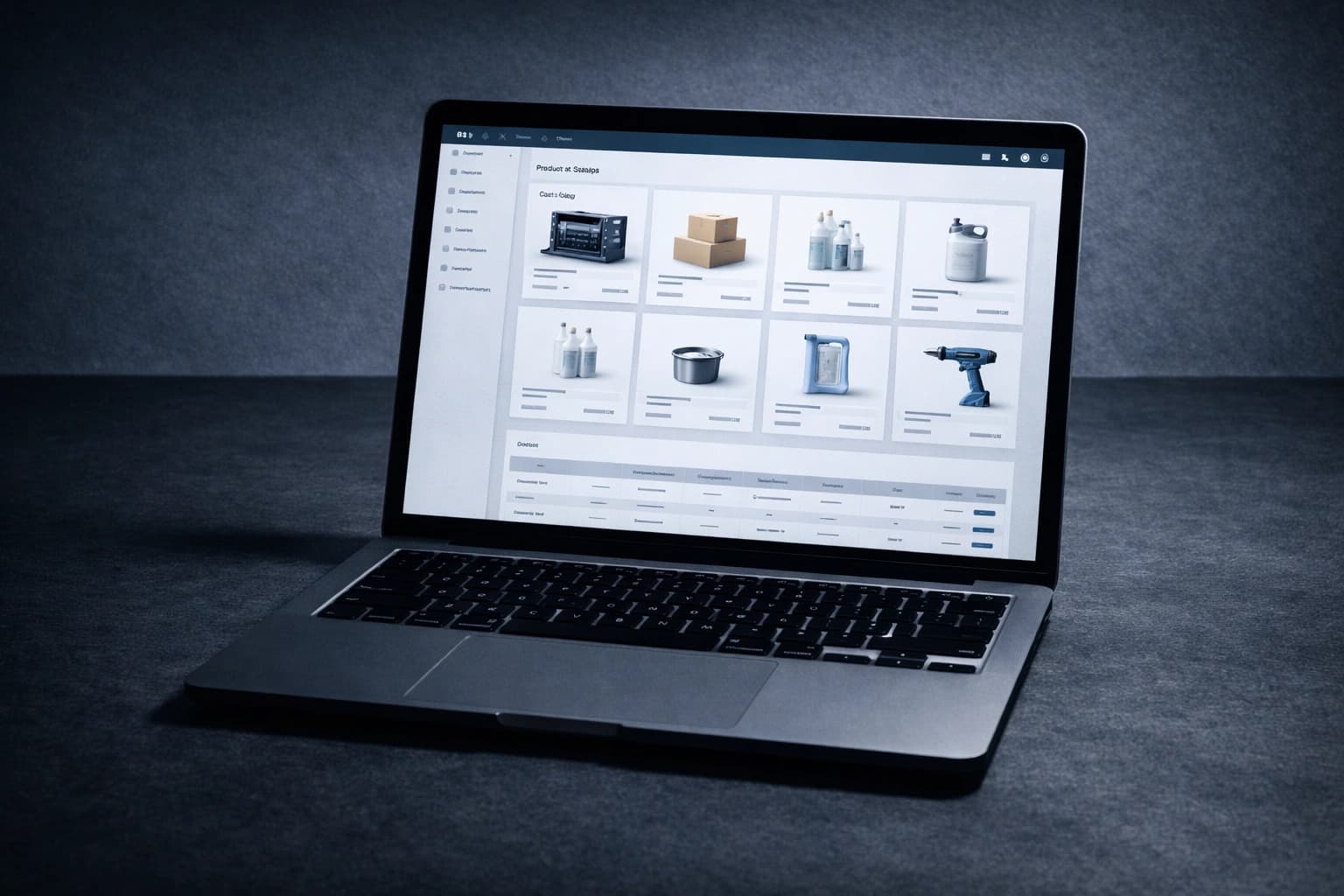
A dealer ordering portal is the most visible component of dealer commerce infrastructure. It is the interface through which dealers interact with the manufacturer's ordering system, the point where the operational architecture becomes tangible to the people it is designed to serve.
Getting it right matters more than most manufacturers anticipate. A portal that is technically deployed but difficult to use will not be adopted. A portal that lacks pricing control or inventory visibility will not reduce the inbound query load it was meant to eliminate. A portal that is not connected to the manufacturer's operational systems will create a data silo rather than a data layer.
This guide covers what a B2B dealer ordering portal needs to do, how it should be architected and what implementation decisions determine whether it delivers its intended operational value.
What a Dealer Ordering Portal Is and Is Not
A dealer ordering portal is a structured, authenticated web environment through which dealers place orders, track fulfillment, manage their account and access relevant documents. It is purpose-built for B2B distribution, not adapted from a consumer e-commerce template.
The distinction matters because B2B dealer ordering has fundamentally different requirements from consumer retail:
- Dealers are authenticated accounts with defined pricing tiers, not anonymous visitors who see a single public price.
- Orders are governed by credit limits, minimum quantities and approval workflows that do not exist in consumer commerce.
- The catalog visible to each dealer is a function of their account classification. Not every product is available to every dealer at every price.
- The relationship is ongoing and account-based. Order history, credit position and document access are persistent account functions, not session-based interactions.
A portal built on consumer e-commerce architecture can approximate some of these functions but it will require significant customization to handle pricing tiers, credit control and account-level catalog management correctly. Purpose-built B2B dealer portals handle these requirements natively.
Core Capability Architecture
A dealer ordering portal that functions as genuine operational infrastructure requires the following capability layers to be present and integrated.
Authentication and account management
Every user who accesses the portal does so through an authenticated account tied to a specific dealership. Multiple users can exist under the same dealer account, including an order desk manager, a warehouse supervisor and a finance contact, with different permission levels governing what each can see and do.
Account management within the portal gives dealers access to their credit limit, current outstanding balance, payment history and active pricing agreements without requiring a call to the manufacturer's finance team.
Account-specific product catalog
The product catalog a dealer sees is determined by their account classification. Products not available to their tier are not shown. Pricing displayed is drawn from their assigned price list, not a generic price that is then manually adjusted. Active schemes applicable to their account are reflected in displayed pricing automatically.
Inventory availability should be surfaced alongside each product, either as a real-time figure drawn from the manufacturer's inventory system or as an availability indicator updated on a defined schedule. Dealers who can see stock levels before ordering do not place orders for products that cannot be fulfilled.
Structured order placement workflow
The order placement workflow must be simple enough for a dealer's order desk staff to complete without training. The path from catalog browse to order confirmation should involve the minimum number of steps necessary to capture a complete, validated order.
Validation happens at submission, not at processing. Product availability is checked. Quantities are validated against minimums and maximums. The total order value is checked against the dealer's available credit. If any validation fails, the dealer is shown a specific, actionable error, not a generic failure message.
Orders that require approval, whether above a value threshold, above a credit limit or containing a non-standard pricing request, are submitted to the appropriate approver automatically. The dealer is informed that the order is pending approval and can see its status in real time.
Order tracking and delivery visibility
After an order is placed and confirmed, the dealer can track its progress through the portal: order confirmed, processing, dispatched, out for delivery and delivered. Where a rider or delivery tracking integration is in place, real-time delivery location may be available.
This visibility eliminates the inbound status query load that consumes operations team time in distribution networks without portal infrastructure. Dealers who can check status themselves do not need to call.
Order history and document access
Dealers can access their full order history, searchable by date, product and order status, without requesting it from the manufacturer. Invoices, delivery notes and credit notes are accessible through the portal, eliminating the email distribution process and ensuring dealers always have access to current documents.
Integration Architecture
A dealer ordering portal that operates in isolation from the manufacturer's operational systems is a data collection tool, not an operational layer. The integration architecture connecting the portal to internal systems determines how much operational value it delivers.
Inventory system integration
Product availability displayed in the portal should reflect the manufacturer's actual inventory position. The integration can be real-time, where the portal queries the inventory system at catalog load, or scheduled, with availability data refreshed on a defined interval. Real-time integration is preferable for fast-moving products. Scheduled updates are acceptable where inventory turnover is lower and the refresh interval is short enough to prevent significant inaccuracy.
ERP and accounting integration
Confirmed portal orders should flow to the manufacturer's ERP or accounting system without manual re-entry. The integration model depends on the systems involved: API-based real-time integration for modern ERP platforms and structured file export for systems with limited API capability.
In the other direction, invoice data generated in the ERP should be accessible to dealers through the portal. This requires either a direct integration that pulls invoice data into the portal or a document sync that makes invoice PDFs available in the dealer's document library.
Delivery tracking integration
Where the manufacturer operates a delivery fleet or uses a logistics partner with tracking capability, integrating delivery status into the portal closes the fulfillment visibility loop. Dealers can see not just that an order has been dispatched but where it currently is and when it is expected to arrive.
Branding and White-Labelling
The dealer ordering portal should be branded to the manufacturer, not to the software vendor who built it. Dealers interact with the manufacturer's brand every time they place an order. That brand experience matters for the integrity of the distribution relationship and for the manufacturer's positioning within their dealer network.
At a minimum, the portal should carry the manufacturer's logo, color palette and domain. A portal accessed at orders.manufacturername.com with the manufacturer's branding throughout signals a different level of operational maturity than a portal accessed at a vendor subdomain carrying the vendor's logo.
For manufacturers deploying across multiple brands or product divisions, the portal architecture should support separate branded environments for each, allowing dealers who interact with multiple divisions to access each through a consistent but division-specific interface.
Implementation Approach
Dealer portal implementation succeeds or fails on decisions made before configuration begins. The following implementation principles consistently produce better outcomes than those that skip them.
Complete the pricing audit before configuration
The portal's pricing engine is only as accurate as the pricing data it is configured with. Before implementation begins, every active price list, every dealer tier assignment and every known pricing exception must be documented. A portal that goes live with incomplete or inaccurate pricing data will generate disputes immediately and erode dealer trust in the system before adoption has a chance to build.
Design the dealer experience, not just the admin interface
The implementation team should walk through the complete order placement workflow from the dealer's perspective before go-live, not just verify that the admin configuration is correct. The number of steps to place an order, the clarity of error messages and the speed of catalog load on mobile are adoption factors that determine whether dealers use the portal or continue ordering through WhatsApp.
Phase the rollout by dealer segment
Full-network rollout on day one creates unnecessary risk. A phased rollout, starting with a pilot group of operationally mature dealers, validating the workflow, identifying and resolving issues then expanding, consistently produces higher adoption rates and fewer post-launch problems than simultaneous deployment.
The pilot group should be selected for operational maturity and relationship quality, not for technical sophistication. If the portal works well for dealers who are representative of the network, it will work well at scale.
Plan for the parallel channel period
During rollout, dealers will continue to place orders through informal channels alongside the portal. This is expected. The implementation plan should define how these orders are handled, ideally through a multi-channel ingestion capability that processes them through the same structured workflow as portal orders, and what the timeline looks like for reducing informal channel volume as portal adoption builds.
Measuring Portal Success
Portal implementation success should be measured against operational outcomes, not deployment milestones. The relevant metrics:
- Portal order share: the percentage of total dealer orders placed through the portal versus informal channels. This should increase over time as adoption builds.
- Inbound status query volume: the number of calls and messages received by the operations team asking for order status. This should decrease as dealers gain portal visibility.
- Order processing error rate: the percentage of orders that require manual correction after submission. This should fall as portal validation replaces manual interpretation of informal orders.
- Pricing dispute frequency: the number of pricing disputes raised by dealers per period. This should drop as system-level pricing enforcement replaces manual price application.
- Time to order confirmation: how long between order submission and confirmed acknowledgment. Portal orders with automated validation should be confirmed significantly faster than manually processed informal orders.
Summary
A B2B dealer ordering portal is not a website. It is operational infrastructure, the dealer-facing layer of a distribution network's order management architecture. Its value is measured not by its design but by its adoption rate, its integration depth and the operational outcomes it produces for both the manufacturer and the dealers who use it.
The capability requirements are defined: account-specific catalog, system-enforced pricing, credit validation at order capture, fulfillment visibility, document access and integration with internal operational systems. The implementation requirements are equally defined: pricing audit before configuration, dealer experience validation before go-live, phased rollout and explicit planning for the parallel channel transition period.
Manufacturers who approach portal implementation as an operational project, not a technology deployment, consistently achieve the adoption rates and operational improvements that justify the investment.